Government of the Russian Empire
The Government InspectorThe Government of the Russian Empire is the distant authority around which the town’s fears and ambitions turn in The Government Inspector. It is not represented chiefly through a visible administrative apparatus, but through the prospect of inspection: a central official may arrive incognito, examine the whole government, and scrutinize the district in particular. That possibility makes official rank a source of both terror and fantasy. The town’s administrators respond not by repairing their abuses, but by arranging appearances that might satisfy power above them.
Authority and the inspection threat
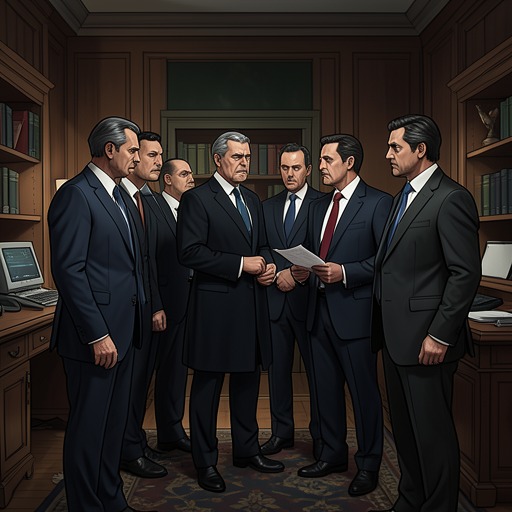
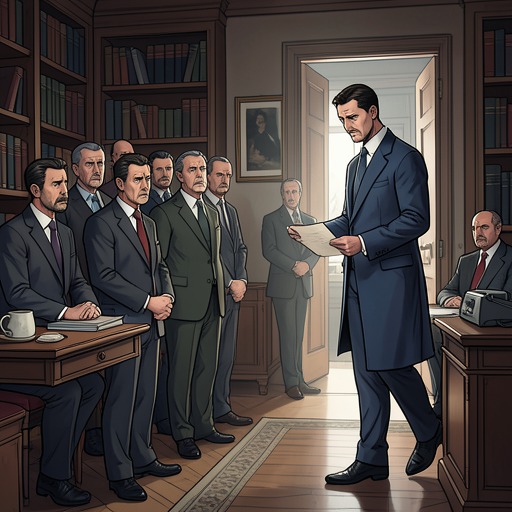
The news that an inspector is coming reaches the town through a letter from Andrei Ivanovich, who reports that an official has arrived with instructions to inspect the whole government and the district especially. The official is said to be posing as a private person and to have secret instructions. The threat is therefore not simply a scheduled review: the inspector’s identity and whereabouts are unknown, leaving the local authorities unable to tell when they are being watched. The governor’s dream of two enormous black rats gives the news a grotesque forewarning, but the practical danger lies in the uncertainty of an inspection that may happen without warning.
The governor immediately distributes warnings according to the responsibilities of his fellow officials. The Superintendent of Charities is told to provide clean nightcaps and keep the patients from appearing as dirty as blacksmiths. The courthouse is to be cleared of geese and goslings that wander among petitioners in the entrance hall. These instructions reveal the gap between an office’s public purpose and its actual condition: a hospital’s patients and a courthouse’s visitors become problems of presentation when oversight is imminent. The proposed response is to make departments look orderly, not to establish that they serve people properly.
That strategy becomes more openly theatrical when the governor orders a tall police sergeant to stand on the bridge for appearance’s sake. An old fence near the bootmaker’s is to be pulled down and replaced with a post and a wisp of straw so that it looks as if grading work is under way. The governor even recognizes that the rubbish piled against the fence will make the town look filthy, yet hopes that debris will testify to visible activity. He instructs officials to report themselves satisfied and threatens anyone who says otherwise with later punishment. The imagined central inspection thus produces a local performance of compliance, backed by coercion rather than administrative improvement.
Local administration and self-protection
The officials’ anxiety is sharpened by the possibility that information about them may reach the center. The governor suspects that merchants have denounced him and asks the postmaster to open letters passing through the office, read them, and either reseal them or deliver them already opened. The postmaster agrees readily, explaining that he already reads letters out of curiosity. A channel that might convey information beyond the town is instead turned into an instrument of local surveillance. The episode shows how the prospect of central oversight is diverted into private self-protection by officials who control access to information.
The governor presents misconduct as ordinary and unavoidable, describing everyone as having sins and appealing to divine order. The judge, by contrast, admits taking bribes, while distinguishing the greyhound puppies he receives from what he regards as more serious forms of corruption. Such exchanges make clear that the problem is not simply fear of a mistaken accusation: the officials openly accommodate private benefit within public office. Their response to inspection is to conceal, rationalize, and manage evidence of this condition.
The town’s claims of good government are especially stark beside the complaints of its merchants. They accuse the governor of quartering soldiers on them, taking goods from their shops, and demanding cloth for his household; they describe his treatment as injurious even while insisting that they obey the regulations. The governor, meanwhile, tells the supposed inspector that the local authorities think only of winning the Government’s esteem through order, vigilance, and efficiency. The discrepancy between that polished account and the merchants’ testimony gives the central authority a double meaning: it is invoked as the standard of proper administration, but the people charged with meeting that standard use their positions to prey on those they govern.
Rank, prestige, and imagined access
The Government also exerts force through hierarchy and the hope of advancement. During his boastful account of life in the capital, Khlestakov claims that his mail is addressed to him as Your Excellency and that he once directed a department. He invents an appointment in which thirty-five thousand couriers fill the streets, and describes officials trembling when he inspects their offices. The governor and the other officials rise in awe as this account grows. Their credulity exposes how strongly they associate proximity to central power with authority, even when the supposed proof comes from an improvised and extravagant story.
That same hierarchy shapes the governor’s private ambitions. After the supposed connection between Khlestakov and the ministers has taken hold, the governor asks whether he might rise to high rank and eventually become a general. His question turns the central administration into a ladder out of provincial life: he imagines promotion not as recognition of better public service, but as the reward of being connected to powerful people. Even the judge’s formal self-presentation as a College Assessor underscores how much the play’s characters inhabit a world measured in titles and rank.
Censorship and the play’s real-world setting
The Government’s significance extends beyond the fictional town to the conditions under which the comedy reached the stage. Under the strict censorship of Czar Nicholas I, permission to produce the play required powerful influence. Gogol’s friend Zhukovsky secured the Czar’s personal intercession, and Nicholas attended the first production in April 1836, laughing and applauding. The reported remark that everybody was implicated, including the Czar himself, makes the event an unusually pointed encounter between the play’s satire and imperial authority.
The production provoked indignation among official Russia and its supporters. Critics accused the comedy of being improbable, coarse, vulgar, without a proper plot, and populated by mere caricatures; one objection was that its town contained no honest person. Gogol, sensitive to the attack, wrote shortly after the St. Petersburg premiere that he was sick of the play and its commotion, even as audiences crowded to see it. The play’s fictional inspection reveals local officials’ efforts to hide their abuses from central power; the history of its production shows that its exposure of official life also had to pass through the censorship and permission of the real imperial state.